
With support from the Cabinet Office and Public Health England, four Office of National Statistics (ONS) subjective wellbeing items have been adopted by the HESA Graduate Outcome survey, which replaces DLHE from 2019. The items were developed by ONS to supplement economic performance metrics; they measure the extent to which graduates feel that the things they do in their lives are satisfying, worthwhile, happy, and not unduly anxious. Graduate data can be compared with UK-wide all-adult data collected through the ONS Annual Population Survey since 2012. Studies by ONS and OECD associate a subjective wellbeing premium with higher levels of education. Alongside these four ONS subjective wellbeing items, HESA’s Graduate Outcome survey will include a “meaningful work” item, and may include a social trust item from 2020.
Pilot studies (Crust and Hicks, 2013) link subjective wellbeing outcomes with subject of study, job title and graduates’ reasons for choosing their jobs. From 2020 graduate wellbeing data will be available to appear in university league tables. These are likely to influence UCAS applicants who want their higher education to improve their life quality, in addition to providing training for work.
What’s the implementation timescale?
First data collection: Sept 2019, from 2017/18 finalists 15 months after completing their degrees.
First league tables: 2020, reporting data collected in September 2019.
First new interventions: 2018/19 to influence June 2019 leavers, surveyed in 2020, reported 2021.
What can universities do with graduate wellbeing data?
Universities and courses can recruit students using subjective wellbeing data collected in the HESA Graduate Outcome survey, with claims such as “our graduates’ lives feel more worthwhile and more satisfying than 80% of UK adults’ lives.” HESA’s Graduate Outcome survey explores how this life quality has been achieved, through graduates’ accounts of their “reasons for taking the job”. This data can be presented to prospective students as an indication of graduates’ autonomy, in messages such as “70% of our graduates are employed in exactly the type of work they wanted”.
Is it possible to improve student wellbeing?
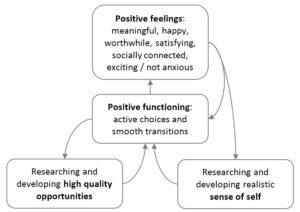
Student wellbeing, autonomy and career development all work the same way. By introducing subjective wellbeing items in the Graduate Outcome survey, HESA enables universities to close the loop in the student development system. The Dynamic DOTS model illustrates this system
What does this mean in practice?
Career advisers, study skill advisers and academics can offer to make students’ lives feel happier, more socially connected, more exciting and less anxious, more satisfying and more worthwhile. In doing so they can improve student performance and career development. Established literatures set out approaches for developing study skills and employability. There is less guidance about improving all students’ wellbeing across the range of higher education contexts, through teaching and learning within and beyond the formal curriculum. Nonetheless, simple, versatile, low-cost interventions exist that yield measurable impacts.
For example, university staff can use HESA’s subjective wellbeing items as life-quality drivers in groupwork which begins with students reviewing and scoring their weekend highlights, or seminars, group presentations, exam preparation etc. on a scale of 0 to 10: satisfying, worthwhile, happy, anxious and socially connected. Then students share approaches to make the experience feel measurably better next time, improving their performance and productivity, and extending their sense of control. Through this sharing, students research and develop their internal and external resources, and improve their choices and transitions. Dynamic DOTS illustrates how this work builds habits of autonomy formulated by Burchardt et al. (2012); it extends external opportunities, raises self-awareness and promotes more active decisions. Through the same process this groupwork drives the four components of career development described by Law and Watts (1977) and identified by Foskett and Johnston (2006) as the principle framework for university career education.
HESA’s subjective wellbeing items can focus students’ attention on choosing goals which feel individually worthwhile, performance and attainment that feels individually satisfying, and lived experience that feels happy, socially connected, and low in uninvited anxiety. Of course, not all anxiety is uninvited. Striving towards challenging, personally worthwhile goals is often anxiety-provoking. Exploring the dynamics of wellbeing and personal productivity can be a valuable part of performance and career development work with students.
Higher education is already well-equipped to deliver subjective wellbeing outcomes and social transformation at a significant scale. Students already invent and share occupational choices which impact on their sense that their lives feel satisfying, worthwhile, happy, socially connected and anxious. The subjective wellbeing framework and data can enable students to evaluate their experience and make better individual choices.
REACH & FIT: each year 2 million UK students can invent, evaluate, select and share interventions
INTENTION: subjective wellbeingcan focus students’ attention on attractive life quality goals
RIGOUR: HESA’s work recycles tried-and-tested ONS wellbeing survey items
FEASIBILITY: higher education already achieves a graduate wellbeing premium
AUTONOMY: extends students’ will-power and way-power, after Snyder in Day et al, 2010
SYNTHESIS: applies Systems Thinking to student performance development
MARKET FORCE: annual UK-wide SWB league tables will drive development in HEIs’ practice
PUBLIC POLICY: supported by Public Health England, Cabinet Office and ONS
CONTINUITY: repurposes existing university student groupwork
PEDIGREE: vast interdisciplinary research literature stretches back to Plato
Managing implementation
Top-down drivers: DVCs Teaching and Learning can be responsible for institutional strategic goals such as to increase mean HESA subjective wellbeing scores as student cohorts progress through the Stages of their taught programme. Measurement can be achieved by including the HESA subjective wellbeing items in the annual online student registration process. Many UK HEIs collect data in this way, for example as part of the HEFCE Career Registration Learning Gain project. Student and graduate data can be compared with ONS UK adult data.
Mid-level drivers: within specific programmes, course leaders can be responsible for improving mean HESA subjective wellbeing scores across the Stages of their programme. Data can be collected through in a variety of settings including student groupwork.
Bottom-up drivers: regularly inviting students to evaluate and improve their subjective wellbeing in the various aspects of their university life frames students as co-producers of transformative student communities rather than passive consumers of educational services. The HESA subjective wellbeing items can structure students’ life quality discourse, particularly where a university’s career education raises students’ awareness of their values and personalities as a basis for worthwhile, day-to-day life-wide occupational choices and satisfying performance.
Getting Started
Careers advisers and study skills advisers may be more familiar and confident delivering groupwork in this style. University counsellors may be more convinced this work will improve student retention, academic performance, NSS scores and completion rates, and help manage demand for their over-stretched services.
The 40-minute How Student Wellbeing Works video guide illustrates approaches for universities to improve students’ and graduates’ subjective wellbeing. This is linked from a trailer is available at https://youtu.be/K0YnhaZ8PZ8
Vice Chancellors can invite key institutional staff such as their institutional Head of Student Career Development, Counselling, Academic Skills Development and Student Union / Association / Guild sabbatical officers to review the 40-minute guide, as a starting place for integrating subjective wellbeing into the student career and performance development curriculum. A key groupwork exercise is described in Section 8 of the video. An annotated script is available via http://bit.ly/HSWWScriptNotes.
If you would like help establishing this provision, please contact Glen Crust at glencrust@hotmail.com